
This document provides a concise overview of Python conditions, branching loops, functions, exception handling, and object-oriented programming summarizing their practical applications and key concepts for effective Python development.
This document explains Python objects and classes, including data types attributes, methods, class construction, and practical examples for object-oriented programming.
This document explains Python exception handling, including try, except, else and finally statements, with practical examples for robust error management and program control.
This document explains Python functions, including built-in and user-defined functions, their syntax, scope, parameters, and practical use cases for code reuse and data processing.
This document explains Python loops, including for and while loops, with practical examples using lists, tuples, and the range function. It covers loop syntax, iteration methods, and common use cases for data manipulation.
This document demonstrates the workflow for writing test assertions, debugging failing tests, and building robust test cases for stack operations in Python.
This document explains the purpose of assertions in testing, describes common PyUnit assertions, and discusses the role of happy and sad paths in test case design.
This document explains the structure of a test case, the role of test fixtures, and how frameworks help developers build assertions for reliable testing.
This document compares Python's unittest and Nose test runners, showing how to run tests, interpret reports, and use coverage tools for better code quality.
This document explains the Red/Green/Refactor workflow in TDD, its steps, and how TDD saves time and improves code reliability.
This document presents a case study on the practical application of TDD and BDD in a real-world software project, highlighting challenges, solutions, and lessons learned for effective testing and delivery.
This document explores the principles and workflows of Test-Driven Development (TDD) and Behavior-Driven Development (BDD), highlighting their benefits techniques, and practical applications in software engineering.
This document compares test-driven development (TDD) and behavior-driven development (BDD), explaining their differences, complementary roles, and how they support robust software design and testing.
This document explores why testing is essential in software engineering drawing lessons from the Apollo program and connecting them to modern DevOps and automation practices.
This document explains the four main levels of software testing—unit integration, system, and acceptance—and describes how each fits into the traditional release cycle and environments.
This document explores common reasons developers avoid testing, the risks of skipping tests, and the long-term benefits of maintaining a robust test suite for code reliability and collaboration.
This document explores the evolution from monolithic to microservices architectures, highlighting their differences, challenges, and best practices for building, scaling, and communicating between services.
This document introduces the essential concepts and building blocks of system design, including client-server architecture, DNS, proxies, HTTP/HTTPS, APIs databases, and scaling strategies for modern applications.
This document provides an overview of the Kubernetes architecture, including its components and how they interact to manage containerized applications.
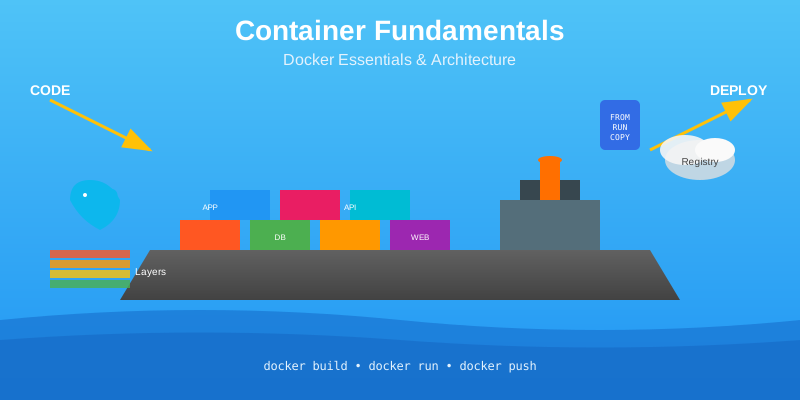
Understand Docker's client-server architecture including components, daemon functionality, registry operations, and the complete containerization process from build to deployment.

📬 Stay Updated
Get tutorials, AI insights, and dev resources straight to your inbox.
No spam. Unsubscribe anytime.



Programming
184
DevOps
52
Troubleshooting
51
Psychology
45
Counselling
41
Python
36
Ai
35
Data-Science
32
Debugging
22
Frontend
22